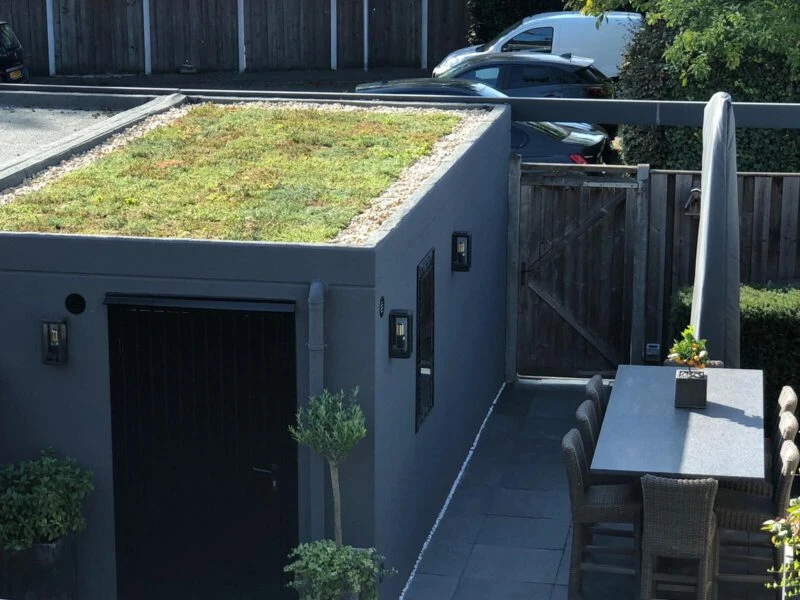
Green roofs are being installed more and more often — and increasingly encouraged. No surprise: a green roof not only looks beautiful, it also offers many advantages. In this article, we’ll tell you everything you need to know before you get started.
Ready-to-install Sedum roof cassette
Is my roof suitable for Sedum or a green roof?
Is my roofing material suitable for a green roof?
Sedum and green roofs are almost inseparable. Sedum is a succulent that is very well suited to rooftops, where moisture and nutrients can be limited. There are hundreds of Sedum varieties, and they all store water in their leaves. They often originate from dry and cold regions. Thanks to the water stored in their leaves, they can easily bridge periods of drought — very useful in these conditions. These properties make Sedum an excellent choice for a worry-free green roof.
Besides the Sedum plant, a good base and proper drainage are essential for a green roof. To live on a roof, Sedum needs a growing medium, also called substrate. Beneath this substrate lies a drainage layer to ensure proper water runoff and provide a small water buffer. The draining function is crucial: if it doesn’t work properly, it can overload the structure with all the associated risks. The small water buffer is also important so that Sedum doesn’t dry out immediately during periods with less rain.
In our Sedum roof cassette, this build-up of drainage layer, substrate, and the Sedum vegetation mat is combined into one ready-to-use product. This means you don’t need to order different materials. It also ensures you don’t have to worry about installing the build-up correctly. If you unexpectedly need access to your roof later, you can easily remove the cassettes and put them back afterwards without ordering new materials.
A green roof has many benefits. Over the past centuries, we humans have removed more and more greenery and replaced it with hard surfaces. As a result, green has less and less room, especially in densely populated areas. If you look at satellite images on Google Maps, you’ll see cities as grey patches on the map among the green rural areas. Cities are covered with concrete, asphalt, roof tiles and roofing membranes.
These are logical materials for good infrastructure and safe housing, but less logical for rainwater retention, CO2 reduction, trapping particulate matter, biodiversity and a healthy living environment. Below we highlight the advantages of a green roof.
A green roof provides excellent insulation for your office or home. This keeps rooms cooler in summer and warmer in winter, so you spend less on heating or cooling.
The government has agreed to be climate neutral by 2050. Installing green roofs can make a significant contribution to this goal. Many municipalities already support the installation of vegetated roofs by offering attractive subsidies.
A green roof captures rainwater. The soil beneath the plants acts like a sponge. It holds water during rainfall and releases moisture to the plants during dry periods. In heavy rain, part of the water is discharged with a delay, helping to prevent peak loads on the sewer system. The rest is taken up by the plants and evaporates back into the atmosphere.
Green roofs help create cleaner air by producing more oxygen and trapping fine dust (particulate matter). Fine dust consists of airborne particles smaller than 10 micrometres. It is considered air pollution because research shows it is harmful to health, damaging the lungs and respiratory tract and being linked to cardiovascular disease.
Soot particles within fine dust are released by the combustion of fossil fuels and by industry. Around 75 percent of total fine dust is caused by human activity. Fine dust also occurs in nature — think of Saharan sand, soil dust, volcanic ash, and even sea salt.
Green roofing can cause fine dust to be retained by plants. Fine dust is not absorbed into the leaves but settles on leaves and branches. It ‘sticks’ and is then washed off by rain and enters the soil. When fine dust passes along a rough or sticky surface, airflow is affected and the particles settle. Hairiness of the leaf surface significantly increases the retention of fine dust.
Evergreen ground covers are effective at capturing particulate matter all year round. The green roofing we offer is wintergreen and therefore optimally effective in trapping fine dust. The most obvious choice is the Sedum roof cassette. But when there is room for an intensive green roof, Hedera (ivy) is a very good choice.
Multiple studies have shown that Hedera is among the most effective plants for capturing fine dust. The very fine hairs on the underside of the leaves bind airborne particles effectively.
Biodiversity is the diversity of life present in your garden and surroundings — think soil life, plants, insects, animals and fungi. This life not only makes your garden more interesting to look at, it also helps the plants in your garden grow better and more completely. If you want more of one of these elements around you, it’s often necessary to introduce another that supports it.
For example, if you want more birds around your home, it’s important to consider what they eat: insects, seeds or fruits. In urban areas, these elements are often lacking, so you’ll need to facilitate them. Plant species that attract insects or bear fruit, which in turn provide food for birds. Every link is important to the success of the next in the chain.
In our range you’ll find many flowering species that attract insects. Catmint (Nepeta) and Geranium (cranesbill) attract many bumblebees and bees. For green roofs, consider the Sedum roof cassette. These cassettes contain a mix of different Sedum species that bloom at different times. This gives you multiple periods of flowering throughout the year and food for wildlife. Together with the soil, these roof plants also provide shelter where insects can hide and live.
More life in your garden creates a pleasant and enjoyable living environment. Life in the garden: beautiful butterflies, squirrels, birds, and more. Relaxing in the fresh air — which is very important in our hectic lives. The sight of a green roof and life in the garden will contribute to a good start to the day when you open the curtains in the morning!
Why do we want to reduce CO2? The Earth receives energy and heat from the sun. To keep the temperature on Earth in balance, the planet must radiate the same amount of energy back into space. CO2 is known to partially absorb the Earth’s heat radiation and make it harder for energy to be radiated back into space, causing temperatures here on Earth to rise — the greenhouse effect.
Because we burn fossil fuels such as coal, oil and natural gas, the carbon dioxide (CO2) stored in them is additionally released into the atmosphere, which means more heat is absorbed. Through photosynthesis, plants and trees convert CO2 into oxygen. With trees and plants, the process can therefore be reversed. But instead of more trees and plants, in recent centuries urbanization has led to less greenery, leaving even more CO2 in the atmosphere.
So we need less CO2 to reduce the greenhouse effect and combat global warming. There are two solutions:
We at Covergreen can especially contribute to the latter. We do this with our ground covers, which ensure that too much maintenance does not have to be a barrier to choosing greenery in your garden instead of paving. A second place with many opportunities to add extra greenery and reduce CO2 is rooftops.
Green roofing converts CO2 into oxygen. We offer solutions for this; the ready-to-install Sedum roof cassette is the most commonly used option. In roof gardens where a deeper growing medium is used, our ground covers can also be applied effectively (project example: Ito Tower, Wencop).
Stuck or unsure? Please contact us or start a chat with one of our team members. We’ll think along with you and provide a suitable solution.
A Sedum roof can be installed year-round. At Covergreen, we offer the ready-to-use Sedum cassette system. You can think of the cassette as a pot around a plant. Placing these cassettes on a roof is essentially the same as moving the pot. Nothing really changes for the roots or the plant itself. That makes the season of installation much less critical.
Our cassettes come from our nursery, where they are cared for optimally. On the roof they often have to continue growing with less attention; in spring and autumn this transition is least noticeable for the plant. These seasons are therefore optimal.
We also offer separate systems where no trays are used. Here we use a build-up with a dimpled drainage mat, substrate and loose Sedum mats. In this case, the season is a factor to consider. The Sedum vegetation mats placed on the substrate still need to root into the substrate. This gives them a larger growing medium and makes them less dependent on weather influences. Rooting into the substrate layer is best done in a growing period with sufficient moisture.
Would you like more advice on this? Please contact us or send us a WhatsApp message.
The desire for a green roof is great, but you do need to check whether it’s realistic for your situation. Ask yourself the following: is my structure suitable for a green roof? Is my roof slope suitable? Is my roofing material appropriate for creating a green roof?
Your structure must be able to carry a weight of 75 kg per m². If there is currently, or used to be, a layer of gravel on the roof, this is often a good indicator that the roof can support a green roof. We always recommend checking the building drawings. If there are no documents or drawings, ask your contractor or structural designer what roof load your structure can handle, or consult your municipality.
The maximum slope at which Sedum roof cassettes can be used is 15 degrees. Above that, there is a risk of the cassettes sliding.
Roofing made of concrete, EPDM or bitumen is suitable for placing a green roof on top. With EPDM or bitumen, always check the condition of the roof and the roofing material. Are there any damages or signs of porosity? Roofing with an age of under 10 years is recommended. Generally not suitable: tiled roofs, sandwich panels and corrugated sheets.
Is a green roof what your garden needs? Then request a price from us. Using our calculator, you can quickly and easily receive a price from one of our sales points in your inbox. You only need to indicate what you want and how many square metres. Prefer to request a price or ask a question directly? Chat with one of our team members.
Back to the overview
Copyright © 2018 - 2026, Covergreen®, All Rights Reserved. Ontwerp website ®reclamemakers. Development website Sitework
Continue with a language of your choice