Looking for an evergreen ground cover? Do you, like us, love a garden that stays colorful and green all year round? No dull, bare garden in autumn or winter? Then you’re in the right place! We offer a wide range of evergreen ground covers. Below you’ll find all the information you need to make the right choice.
Which ground covers are evergreen?
Which ground covers are not evergreen?
What should I consider when choosing evergreen ground covers?
Evergreen doesn’t literally refer to the color green, as many people think. It means that the plant, shrub, or tree keeps its leaves during the winter. This doesn’t mean that these plants never shed leaves, but rather that they don’t lose all their foliage at once (which would make them completely bare).
Most evergreen plants gradually renew their leaves. The lifespan of leaves on evergreen species can range from one year to as long as 45 years for some conifers. Generally, most plants renew their foliage within five years.
Here we’ll focus on our own selection of evergreen ground covers. With two exceptions, the entire Covergreen range consists of evergreen varieties.
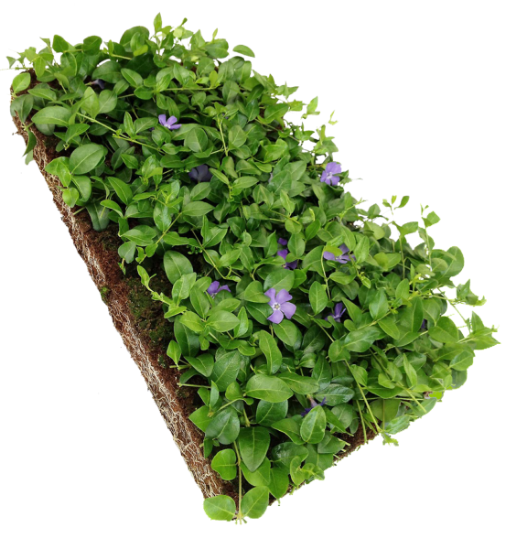
The Periwinkle (Vinca minor) plant mat is a beautiful, low-growing plant that forms a lush, always-green carpet over the soil. Typically, it blooms in spring around April–May and sometimes again in autumn. The flowers are about 2 cm in size, and the plant is very winter hardy. The white-flowering Vinca minor ‘Alba’ and the purple/red-flowering Vinca minor ‘Atropurpurea’ mainly differ from the blue-flowering Vinca minor in their bloom color.
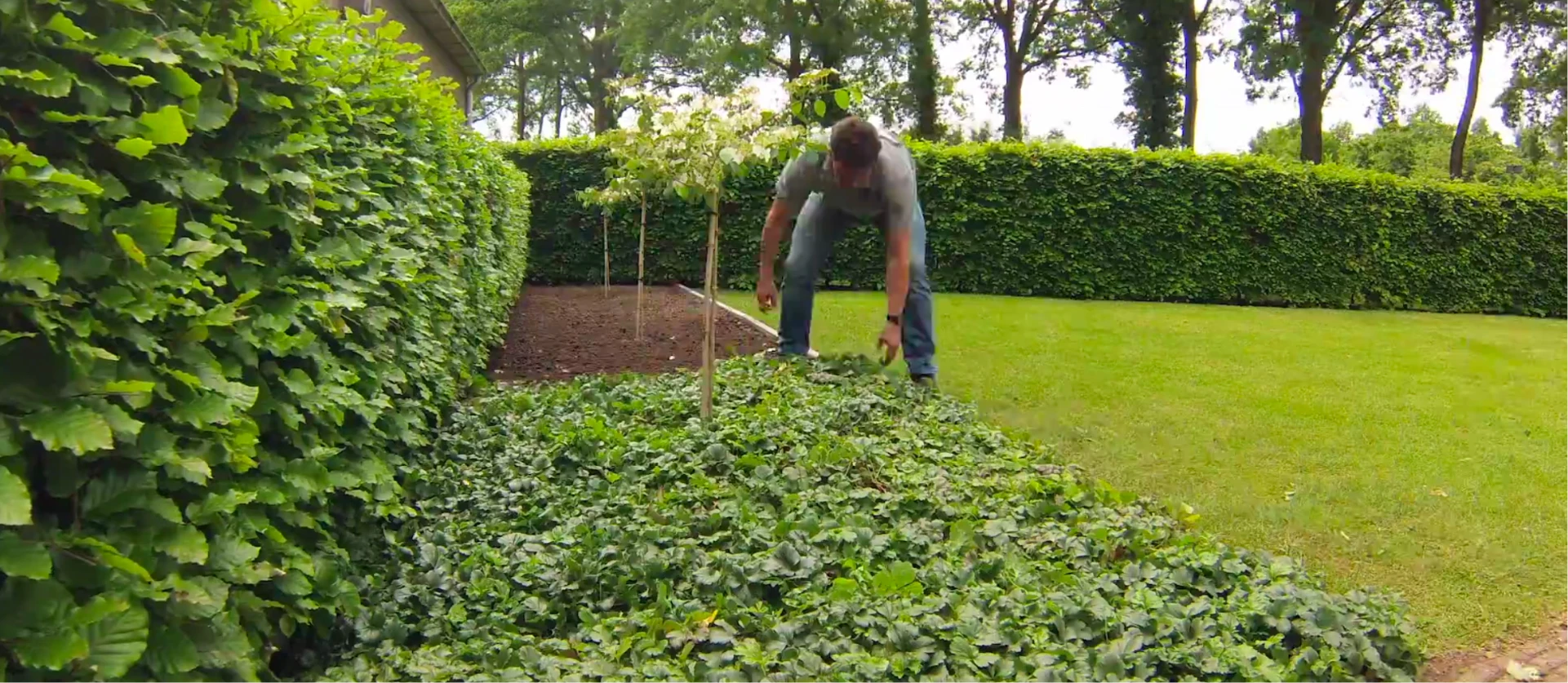
Waldsteinia ternata is another evergreen, foliage-retaining ground cover. At first glance, it looks somewhat like a strawberry plant. In spring and summer, it has fresh green leaves that turn darker towards autumn. In winter, the leaves remain partly green, with some orange and yellow tones appearing.
In the following spring, the old discolored leaves are replaced by new bright green ones. This natural renewal process allows Waldsteinia to rejuvenate itself. The new growth shades the old leaves, causing them to die off. Waldsteinia’s flowers are yellow.
The Hedera helix ‘Woerner’ (Ivy) is a strong evergreen ground cover in the Covergreen range. It grows long vines with heart-shaped dark green leaves. The leaves only fall off when new shoots overgrow the old ones and block sunlight. During winter, ivy becomes a darker green, while in spring it turns a lighter, fresher shade.
Sedum plant mats and Sedum roof cassettes are very hardy and keep their thick leaves year-round. During winter and dry periods, Sedum often develops a red hue, which returns to green once moisture and warmer temperatures return. Sedum stores water in its leaves to survive cold or dry periods. Because our Sedum mats are made from a mix of different species, you’ll see multiple bloom colors throughout the growing season (April to September).
Among the non-evergreen species, we again focus only on those available in the Covergreen range.
The Geranium cantabrigiense ‘Biokovo’ (Cranesbill) develops beautiful autumn colors in shades of red, orange, and yellow. During winter, it retains much of this foliage, adding decorative value late into the season. By the end of winter, the old leaves have died off and can be removed. In spring, new shoots appear with fresh green leaves, followed soon after by buds. By May, the first white-pink flowers start to bloom.
The second non-evergreen ground cover in our range is Catmint (Nepeta x faassenii ‘Walker’s Low’). Its foliage dies back during winter. At the end of winter, you can trim the old leaves down to about 5 cm above the ground. This gives new shoots space to grow in spring. The first purple flowers appear around June.
To answer this question properly, it’s helpful to understand why some plants lose their leaves. Plants shed their foliage to survive winter or drought. Most evergreen plants are naturally found in warm and humid climates. In warm regions with dry seasons, both evergreen and deciduous plants can coexist.
In temperate climates like the Netherlands, most species are deciduous. Evergreen plants generally cannot withstand temperatures below -25 °C. This means that evergreens are less tolerant of extreme cold and long dry periods compared to deciduous plants.
While extreme cold cannot be controlled, Dutch winters pose no real problem for most evergreen species. The main factor to watch for is sufficient soil moisture during prolonged dry spells. For evergreen ground covers, make sure the soil remains moist enough — you may need to water manually during very dry periods.
“Evergreen” and “wintergreen” are synonyms. A wintergreen ground cover, like an evergreen one, does not lose its leaves during winter months. The list of wintergreen ground covers is therefore the same as our evergreen selection.
However, there is a difference between evergreen and winter-hardy ground covers. We’ve written a detailed article about this — you can read it by clicking the link.
Once the soil has been leveled and prepared (see our installation guide here), Covergreen plant mats can be laid quickly and easily. The mats measure 57×38 cm and weigh around 4 kg, making them easy to handle. Unlike traditional planting, Covergreen mats are not planted into the ground — they are placed on top, and the roots naturally grow into the soil below.
With Covergreen ground covers, you not only get evergreen plants, but also an instantly green result. Because we supply the ground cover as fully grown plant mats, your garden will be lush and completely covered right away. Ready-to-use and easy to install.
Are evergreen ground covers what your garden needs? Then request a quote from us. Using our calculator, you can quickly and easily receive a price estimate from one of our sales partners straight to your inbox. Just indicate which ground cover you want and how many square meters you need. Prefer to get an instant price or ask a question directly? Chat with one of our team members.
Back to the overview
Copyright © 2018 - 2026, Covergreen®, All Rights Reserved. Ontwerp website ®reclamemakers. Development website Sitework
Continue with a language of your choice